Friday, 25 November 2011

Art and Marxism 25/11/11

Art as an IDEOLOGY and art as a weapon.

Marx talks about praxis - theory and practice intrinsically linked.

Theory without practice is useless, practice without theory is uninformed.

SYNERGY of philosophy and practice.

Peoples values reflect the economic structure of society.

"The mode of production of material life conditions the social, political and intellectual life process in general. It is not the consciousness of men that determines their being, but on the contrary it is their social being that determines their consciousness. At a certain stage in their developement, the material productive forces of society come into conflict with the existing relations of production.

(like advances in technology? growing material resources? redundancy??)

... From forms of developement of the productive forces, these relations turn into their fetters. Then begins an era of social revolution.

(are we talking like the ludites smashing the machines in the factories?)

With the change in economic foundation the whole immense superstructure is more or less rapidly transformed. In considering such transformations it is always necessary to distinguish between the material transformation of the economic conditions of production, which can be determined with the precision of natural science, and the legal, political, religious, artistic or philosophic, in short, ideological forms in which men become conscious of this conflict and fight it out."

(punk was a response to a lack of jobs for young people who wanted to work. angry youth rising up and "fighting the power". DIALECTICAL MATERIALISM > the synergy was, capitalism won and enveloped those ideals for sale.)
Karl Marx (1857) 'Contribution to the critique of Political Economy'

BASE AND SUPERSTRUCTURE

SUPERSTRUCTURE - (art, politics, culture)
emerges from the BASE - (PROLETARIAT - MIDDLE CLASSES)
It reflects and legitimizes the relationship between the two BASE classes.

Politics serves to enforce a class system.

Education under CAPITALISM is competitive, it values the goal over the process.

'[The ruling class has] to represent its interest as the common interest of all the members of society, ... to give its ideas the form of universallity, and represent them as the only rational universally valid ones."
Marx, (1846) The German Ideology

Family and Marriage - serve as an institution to protect private wealth.
Men want their wealth passed down to their children, but the only way they know who their kids are is by keeping in touch with the woman who gave birth to them.


IDEOLOGY - masks, distorts, disguises, and promotes a FALSE CONCIOUSNESS, a system of belief

- the ruling class have to present their ideals as truth
- culture has its root in class division

CULTURE is self perpetuating.

ART PRODUCTION - at one point, only the upper classes made and bought art. depending on what they thought was valuable.

"Whether an individual like Raphael develops his talents depends entirely on demand, which in turn depends entirely on the division of labour and the educational conditions of men which result from it.
The exclusive concentration of artistic talent in single individuals and its supression in the broad mass of people which this entails is a consequence of the division of labour...
In a communist society there are no painters but only people who engage in painting among other activities"
Karl Marx (1845) The German Ideology

Art has always had an upper class agenda until recently.

RELATIONAL AESTHETICS
- focus on human relationships
- collaborative art
- anti-gallery

The gallery is a massively restricted art space and an upper class institution. The space is PANOPTIC and enforces authority.

Related artists:

Viktor Burgin

Nicolas Bourriaud - Theorist

KEY TERMS:

FORDISM (The production line), TAYLORISM, GLOBALISATION, EXCHANGE VALUE, USE VALUE,  ALIENATION, REIFICATION, ATOMISATION, COMMODITY FETISH, FALSE CONSCIOUSNESS, INCORPORATION, CULTURE INDUSTRY

Friday, 11 November 2011

TASK 1b - Panopticism and the Olympics


The Olympic games could be seen as a panoptic phenomenon. It is a “disciplinary project," the participants of which constantly self regulate to meet an institutional standard. They are “docile bodies”, not only that but they are admired by the general public.
The architecture of the stadium is similar to that of the Panopticon. A demonstration of institutional discipline and the effects of adhering to those strict values replace the central tower.  There is communication barrier between the institution and the public. The games are televised in such a way that lends itself to manipulation and spin; the only other option is to pay for a ticket, which for the general public is not financially viable.
McDonalds and Lloyds TSB sponsor the games this year. Any outlet along the route of symbolic torch ceremony has to make sure they do not associate themselves with the games. "Even involuntary association with the Games by local businesses – who didn't actually screw over the whole country – will result in punishment."  [Marina Hyde - the guardian.] Buildings along the way are to be decorated with flower boxes displaying the colours of the Olympic games. Lloyds are making a significant amount of profit and extending their influence through the games, leading the public to associate them with high standards of discipline and rewards. After the general public bailed them out financially, it feels like a right kick in the teeth. The Olympics are serving as a symbolic exercise in power reinforcement by the institutions. The gaze is ever present from the popular media and CCTV, “a system of permanent registration” which is “constantly centralized.” The institutions are flexing their muscles.

The olympics are a specific idea, but these ideas can be used in relation to popular televised sport. 


Notes:

The architectural design -

lights from around it backlighting audience. the power is centre, the promise of self satisfaction.
concept of "being the best" reaching for something. sponsored this year by mcdonalds, lloyds tsb etc

fake promise. what do the athletes get? the gaze of the institution.the corporate sponsors make the money.
the collisseum. literally, but how does it translate?

the upperclasses can look on it. an experiment. docile bodies responding to a institutional view of human perfection. or is it more primal?

binary division = win or lose


I just found this article and I'm beginning to think that the 2012 olympics are in many ways Panoptic.

http://www.guardian.co.uk/sport/blog/2011/nov/09/london-2012-olympic-torch-route?newsfeed=true

The architecture of the stadium has some parallels of the panopticon.
But its more that the athletes are engaging with a solid set of standards defined partly by an institution but also by what I assume are primal instincts to be fit and healthy in order to survive although we dont need to be fit and healthy to live now. Does this make them docile bodies?

Its directly based on the design of the collisseum which was used for people to watch people less fortunate that themselves be eaten by Lions or demonstrate remarkable skill.
Then, the blood and torture would serve as warning of how the institution would punish you if you went out of line. I'm struggling to draw parallels now, the only thing I can think is that were watching a group of totally docile bodies demonstrating what they can do and aspiring to it.

The amount of protection for the torch and the event as a whole symbol of the instition is scary. The article talks about changing peoples flower boxes that are en route to fit the colour scheme and any business being told that they cannot claim to be associated with it in any way. I assume thats becuase its sponsored by MacDonalds and Lloyds TSB.

even involuntary association with the Games by local businesses – who didn't actually screw over the whole country – will result in punishment.  Marina Hyde - the guardian

Lloyds being given the rights is a kick in the nuts becuase it means they can make more money from the general public after "suffering" the crash and being bailed out by us.
The institution are flexing their muscles I think. Publicly televising the whole lot is interesting, prone to censorship and manipulation it serves as a demonstration of the metaphor of the dividing walls of the panopticon. The walls are a communication barrier serving to confuse and mislead rather than block.

This is my understanding, is it making sense?

Wednesday, 9 November 2011

TASK 1a - Virtual Social Networking as the Panopticon

Social Networking is a Panopticon, functioning as a laboratory in which we are both the observer and the observed. Your social networking profile acts as a captive silhouette within the Panopticon.  Our society is readily available for “an investigation that extends without limit to a meticulous and ever more analytical observation.” The divided cells in the Panopticon “impose on [him] the individual, a lateral invisibility,” manifested in social networking as a thoroughly limited form of communication which is also prone to constant monitoring by the institutional gaze. Social networking allows for the “leniency of a penalty that [would be] is interlaced with the ruthless curiosity of an examination,” the object does not have to be forced to partake. In terms of basic human interaction, it “automatizes and disindividualizes power.” Anyone can scrutinize an individual and use their registered information against them. On the subject of personal information, the act alone of engaging with a social network is an act of permanent registration and centralising of personal information. We have no control over the information that our registered social groups publicize about us. We are half way to becoming docile bodies just from the fear of our information being so readily available. We are already self-regulatory, we choose what we show and tell about ourselves and undertake self-disciplinary action when we commit a social faux-pas through an act of guilt or reconciliation, but we do so in the hopes of developing more intimate relationships that will that will empower us. In a virtual social network, individuals are not only lured by an illusion of intimacy, they also begin associate social interaction with instruction through advertising and policy. Social networking sites are now almost an unavoidable part of life in our society. People have become arranged “according to a double mode; that of binary division.” You are either registered for the great experiment, or you are isolated.

Extra...
Facebook is developing technology that could potentially be used for greater monitering. Paired with mobile phones it now has the option to post your location automatically whenever you travel, based on the idea that your peers will be able to find you easier. While you can turn it off, it still raises awareness of the institutional gaze and extends it further.

Creative networks such as soundcloud and flickr allow for individuals to post their produce up online for easier distribution to the masses. Institutions use these services to tap into a great resource of copywrite free material and keep their finger on the pulse. This is then fed back to us by the institutions. We observe trends presented to us by the institutions before they develop into any new or challenging to them.

Monday, 7 November 2011

Panopticism Seminar 4/11/11

Western philosophy has a focus on Descartes.
"I think therefore I am"
We are individual free thinkers.

The idea of panopticism contradicts this.

The Panopticism was designed by Jeremy Betham in 1891.
Foucault began writing about it in the 1970s.

The Panopticon

- individuals are totally individualised and seperated. it is a purely mental experience.
- it is a constant reminder that someone may be watching
- you are constantly visible
- your supervisors are invisible to you but the central tower is there
- it is the INSTITUTIONAL GAZE, a constant reminder by a SYMBOL

Under the gaze of the panopticon people;

- are self regulatory
- act in a way that they think they should act in within the institution
     the values of the institution are coded into us by ideas that are shown to us in various
     institutions through the process of growing up in society, the macro-dynamic, it is self
     perpetuating knowledge
- experience a shift in social discipline from exclusion to conditioning

As a laboratory it allows constant research
As a prison it is mental torture. People go mad from "paranoia."

Foucault - "Power is a relationship that two people enter into. It is a process of communication."
People allow themselves to be controlled.

A group of people interacting and communicating for a society.
Institutions emerge.
The duality of "madness" and "sanity"
Professionals are instated to diagnose people on the values of the institutions.
This DISCIPLINARY SOCIETY creates DOCILE BODIES.

Docile Body
- utterly conforms
- does not challenge
- works really hard
- SELF REGULATORY
- SELF DISCIPLINARY

"Surveillance is based on a system of PERMANENT REGISTRATION"

"The registration is constantly CENTRALIZED."

Your knowledge of yourself moves away from you into the system. (facebook, public records, doctors records, criminal records, credit history, birth certificates, etc etc)


"The plague is met by disorder"
The society put mechanisms in place when they were under threat that gave rise to a political dream.
Out of crisis came a system of total control.

"The plague gave rise to disciplinary projects"

The plague is a metaphor for social wrongness.

"the great confinement on the one hand; the correct training on the other. The leper and his separation; the plague and its segmentations. The first is marked, the second analyzed and distributed"

"The first is that of pure community, the second that of a disciplined society."

"The town immobilized by the functioning of an extensize power that bears in a distinct way over all individual bodies - this is the utopia of the perfectly governed city."

It is the pentration of regulation in every aspect of every day life.

"individualize the excluded, but use procedures of individualization to mark exclusion - this is what was operated regularly by DISCIPLINARY POWER  from the beginning of the nineteenth century in the psychiatric asylum, the penitentiary, the reformatory, the approved school and to some extent, the hospital.
Generally speaking, all the authorities excercising individual control function according to a double mode; that of BINARY DIVISION and branding (mad/sane; dangerous/harmless; normal;abnormal); and that of coercive assignment, of differential distribution (who he is; where he must be; how he is to be characterized; how he is to be recognized; how a CONSTANT SURVEILLANCE is to be excersized over him in an INDIVIDUAL way, etc.). On the one hand, the lepers are treated as plague victims; the tactics of individualizing disciplines are imposed on the excluded; and, on the other hand, the universality of disciplinary controls makes it possible to brand the 'leper' and to bring into play against him the dualistic mechanisms of exclusion. The constant division between the normal and abnormal, to which every individual is subjected, brings us back to our own time, by applying the BINARY BRANDING and exile of the leper to quite different objects."

"By the effect of the backlighting, one can observe from the tower, standing out precisely against the light, the small captive shadows in the cells of the periphary. They are like so many cages, so many small theatres, in which each actor is alone, perfectly individualized and constantly visible."

"Visibility is a trap."

"He is seen but does not see; he is the object of information, never a subject in communication."

"this invisibility is a guarantee of order"

"Hence the major effect of the Panopticon: to induce in the inmate a state of concious and permanent visibility that assures the automatic functioning of power. So to arrange things that the surveillance is permanent in its effects, even it is discontinuous in its action; that the perfection of power should tent to render its actual excersize unnecessary."

it eliminates the ability to return the gaze so you become the object. you act like the object.

"it automizes and disindividualizes power."

"a real subjection is born mechanically from a ficticious relation."

as a laboratory it serves to "train or correct individuals. To experiment with medicines and monitor their effects. To try out different punishments on prisoners, according to their crimes and character, and to seek the most effective ones. To teach different techniques simultaneously to the workers, to decide wich is the best. To try out pedagogical experiments - and in particular to take up once again the well debated problem of secluded education, by using orphans. One would see what would happen when, in their sixteenth of eighteenth year, they were presented with other boys or girls; one could verify whether, as Helvetius thought, anyone could learn anything; one would follow the 'genealogy of every observable idea'; one could bring up different children according to different systems of though, making certain children beleive that two and two do not make four or that the moon is a cheese, then put them together when they are twenty or twenty five years old; one would then have discussions that would be worth a great deal more than the sermons or lectures on which so much money is spent; one would have at least an opportunity of making discoveries in the domain of metaphysics. The Panopticon is a privilaged place for experiments on men, and for analysing with complete certainty the transformations that may be obtained from them. "


"the ideal point of penality today would be an indefinite discipline: an interrogation without end, an investigation that would be extended without liit to a meticulous and ever more analytical observation, a judgement that would at the same time be the constitution of a file that was never closed, the calculated leniancy of a penalty that would be interlaced with the ruthless curiosity of an examination"

"A Scanner Darky" by Phillip K Dick is ab observation of Panopticism in a futuristic, distopian society.

Identity 04/11/11


- Look at historical conceptions of identity
- Foucaults and Cavallero, discourse analysis
- Baumans theory of identity

Essentialism was the traditional approach.
It talks about the biological - the inner essence.
It denies changing sexuality or gender, it is related to physiognomy and phrenology
It seems to often legitimise racism.

Post-Modern theorists deny this and are therefore Anti-Essentialist.

Nietzche wrote Man and Superman, which inspired Hitlers Arean race.

Chris Ofilis works deal with his identity as a black man.
His "virgin mary" painting caused some controversy, as she was depicted as black and as a large pile of elephant dung. It looks as though she is also surrounded by bums and vaginas. It was removed from an exhibition at the Tate.


Chris Ofili - "Virgin Mary" - image

Pre-Modern identity was defined by long standing roles in society. "secure identity" There was little movement up or down the social ladder. There were defined by institutions such as marriage, school, class.
To every position such as farm worker, soldier, factory worker, housewife, gentleman there was a related institutional agency with a vested interest in keeping people where they were.
 
Farm-worker ……….  landed gentry

The Soldier  …….  The state

The Factory Worker…  Industrial capitalism

The Housewife……  patriarchy

The Gentleman….  patriarchy
Husband-Wife (family)…..  Marriage/church

Baudelaire introduces the "the flaneur" or the gentleman stroller. His clothes and act of being out for leisure set him in high society.

Simmels trickle down theory is introduced. The lower classes buy cheap imitations of upper class fashion.

The idea of the bubble up theory is now evident, the upper classes wear trends that have come from the lower classes. For example, baggy clothes were made fashionable in poorer areas where it was logical to buy looser fitting clothes so people would grow into them. Rips in jeans, paint and bleach on clothes etc etc.

‘The feeling of isolation is rarely as decisive and intense when one actually finds oneself physically alone,
as when one is a stranger without relations, among many physically close persons, at a party, on the train, or
in the traffic of a large city’- George Simmel

Simmel suggests that because of the speed and mutability of modernity,
individuals withdraw into themselves to find peace. He describes this as
‘the separation of the subjective from the objective life.’

Postmodern Identity can be constructed. "The Fragmented Self"

Foucault suggests that identity is constructed out of the discourses available to us.

Cavallero defines discourse as "... a set of recurring statements that define a particular cultural 'object.'
(e.g. madness, criminality, sexuality) and provide concepts and terms through which such an object can be studied and discussed.'

Possible discourses: Age, Class, Gender, Nationality, Race/Ethnicity, Sexual Orientation, Education, Education, Income

Class, Nationality,
Race / Ethnicity, Sexuality / Gender (otherness)

Class.
definition - 1. there are different classes
                 2. to have class (upperclass)

Children playing with chicken feet - image
women watching shakespeare play - image

men in pub - image

  Humphrey Spender/Mass Observation, Worktown project, 1937

The above photographs were taken by two upperclass photographers.
They are observations of the working class.
The first is taken in a pub, there is question as to whether the guy at the back
is offering a freindly wave or telling them to fuck off.
The second is of two young lads playing with chicken feet.
The third of a small group of people watching a shakespearian reproduction.


Martin Parr - The Last Resort, taken at New Brighton, Merseyside 1983 - 85


Martin Parr - Ascot 2003

‘ “Society” …reminds one of a particularly shrewd,
cunning and pokerfaced player in the game of life,
cheating if given a chance, flouting rules whenever
possible’ Bauman on Identity, 2003

To me, the above photographs are about the class system and the desire to climb the social ladder by imitation of styles and trends and by an ideal being worth more than the actual experience, eg, a day at the beach. This could be nothing more than a class based stereotype?

Nationality


Martin Parr - Think of England 2000 - 2003


Martin Parr - Think of Germany, Berlin 2002

Playing on national stereotypes.


Alexander McQueen - Highland Rape

'Much of the press coverage
centred around accusations
of misogyny because of the
imagery of semi-naked,
staggering and brutalized
women, in conjunction with
the word “rape” in the title. 
But McQueen claimed that
the rape was of Scotland, not
the individual models, as the
theme of the show was the
Jacobite rebellion.'

Evans, C. ‘Desire and Dread: Alexander McQueen and the Contemporary
Femme Fatale’ in Entwistle, J. and Wilson, M., (2001), Body Dressing, Oxford,
Berg, page 202

I appreciate that this show was playing with socio-historical events and ideas but the expectation of an audience to look for and understand a loose metaphor in a piece of visual art seems pretentious and self indulgent. Or maybe its raising awareness of social injustice in the past in order to awaken peoples eyes to it in the present day. Who knows. 

‘I didn’t like Europe as much as I liked Disney World.  At
Disney World all the countries are much closer together, and
they just show you the best of each country.  Europe is more
boring.  People talk strange languages and things are dirty.
Sometimes you don’t see anything interesting in Europe for
days, but at Disney World something different happens all the
time, and people are happy.  It’s much more fun.  It’s well
designed!’
A college graduate just back from her first trip to Europe, in Papanek, V. (1995), The Green Imperative: Ecology and Ethics in Design and Architecture, London, Thames and Hudson, page 139

Race / Ethnicity


Captain Shit and the legend of the Black Stars - Chris Ofili

The painting is mouned on elephant dung, the image is of a black super hero.
Its rare that you see a black superhero, in fact I cant think of one in popular superhero comics.

 Emily Bates created a dress made out of Ginger hair.
 
‘Hair has been a big issue throughout my life… It often felt that I was

nothing more than my hair in other peoples’ eyes’

Emily Bates, Textile Designer/Artist

Gender and Sexuality


‘Edmund Bergler, an American psychoanalyst

writing in the 1950s, went much further, both in

condemning the ugliness of fashion and in relating

it to sex.  He recognised that the fashion industry

is the work not of women, but of men.  Its

monstrosities, he argued, were a “gigantic

unconscious hoax” perpetrated on women by the

arch villains of the Cold War –male homosexuals

(for he made the vulgar assumption that all dress

designers are “queers”).  Having first, in the 1920s,

tried to turn women into boys, they had latterly

expressed their secret hatred of women by forcing

them into exaggerated, ridiculous, hideous clothes’

Wilson, E. (1985), Adorned in Dreams: Fashion and Modernity, London, I.B. Tauris, page 94


this quote seems to be referring to flapper culture,
dress, hair, blond, smoking, flat-chested, and chic


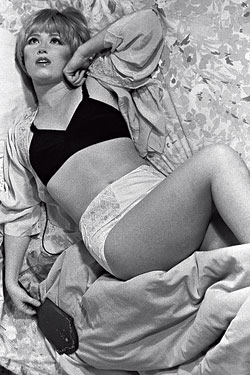
Sindy Shermans - Untitled Film Stills

examining the female image in the media, the mirror represents vanity, to me she has a daft expression on her face, although its kind of spooky. Like she might be dead. The gaze is directed away from us. The photographer is the model. 


Sarah Lucas - Au Natural

again looking at sexuality and gender. the bucket is funny, but caused controversy.

 The Post-modern condition
Liquid modernity and Liquid Love


•Identity is constructed through our social experience.
•Erving Goffman The Presentation of Self in Everyday Life (1959)
•Goffman saw life as ‘theatre’, made up of ‘encounters’ and ‘performances’
•For Goffman the self is a series of facades
This is similar to wearing a mask. In councilling and therapy this idea is used to contradict
the idea that the self and solid and people can't change. It can be a comforting and useful concept.
‘Yes, indeed, “identity” is revealed to us only as something to be invented
rather than discovered; as a target of an effort, “an objective"
Zygmunt Bauman 

‘In airports and other public spaces, people with mobile-phone headset attachments walk around, 
talking aloud and alone, like paranoid schizophrenics, oblivious to their immediate surroundings.
Introspection is a disappearing act. Faced with moments alone in their cars, on the street or at supermarket 
checkouts, more and more people do not collect their thoughts, but scan their mobile phone messages for
shreds of evidence that someone, somewhere may need or want them.’ Andy Hargreaves, 2003
‘We use art, architecture, literature, and the rest, and advertising as well, to
shield ourselves, in advance of experience, from the stark and plain reality in
which we are fated to live’. Theodor Levitt - The Morality (?) of advertising

Post Modern Identity
 "I shop Therefore I am" Barbara Kruger ad campaign for Miss Selfridges
"Buy it it will change your life" Posters etc
“The typical cultural spectator of 
postmodernity is viewed as a largely home 
centred and increasingly solitary player who, 
via various forms of ‘telemediation’ (stereos, 
game consoles, videos and televisions), 
revels in a domesticated (i.e. private and 
tamed) ‘world at a distance’" Darley - 2000, Visual Digital Culture
I have attempted a Foucaudian analysis of faceback that kind of rings with that Darley quote.
 Facebook reduces your social skills by introducing a system that creates the illusion of order and a dualistic approach to relationships. You end up complying to either "we are freinds" or "we are not freinds" approach to it which affects the way you view youre interactions in the real world.
You end up complying to the facebook institution and its values and letting that govern your social life, sometimes to the extent that just becuase a person denies your freind request online you are subject to self disciplinary action such as self-guilt and scrutiny when in the real world there could be many reasons that that person has denied your freind request, ignored your message etc, such as technical faults, human error or misunderstanding.

That could be how through compliance to a system and disciplinary action, facebook turns us into socially docile bodies.
 
‘Fun they may be, these virtual communities, but they create only an illusion of intimacy and a pretence of community’

Charles Handy (2001), The Elephant and the Flea, Hutchinson, page 204
“The notion ‘you are who you pretend to be’ has a mythic
resonance.  The Pygmalion story endures because it
speaks to a powerful fantasy: that we are not limited by our
histories, that we can be recreated or can recreate
ourselves... Virtual worlds provide environments for
experiences that may be hard to come by in the real”

Sherry Turkle (1994), Constructions and Reconstructions of the Self in Virtual Reality

‘In the brave new world of fleeting chances and frail
securities, the old-style stiff and non-negotiable identities
simply won’t do’

Bauman (2004), Identity, page 27
‘ “Identity” is a hopelessly ambiguous idea and a

double-edged sword.  It may be a war-cry of

individuals, or of the communities that wish to be

imagined by them.  At one time the edge of identity

is turned against “collective pressures” by

individuals who resent conformity and hold dear

their own ways of living (which “the group” would

decry as prejudices) and their own ways of living

(which “the group” would condemn as cases of

“deviation” or “silliness”, but at any rate of

abnormality, needing to be cured or punished’

Bauman (2004), Identity, page 76