Sunday, 16 October 2011

LEVEL 5 - Lecure 1, Panopticism. (14/10/11)

Literature, art and their respective producers do not exist independently of a complex institutional framework which authorises, enables, empowers and legitimises them. This framework must be incorporated into any analysis that pretends to provide a thorough understanding of cultural goods and practices.’ Randal Johnson in Walker & Chaplin (1999)


The Panopticon - Jeremy Bentham (1971)


Foucault says that forms of knowledge such as biology, medicine and psychiatry, legitimise the use of hospitals school and prisons.

These institutions effect us by internalising our responsibility.


Punishments and technology such as execution, the stocks, torture and prison were / are used as forms of discipline to prevent people from breaking the rules instated by the wealthy and powerful in our society.


Discipline is a ‘technology’ [aimed at] ‘how to keep someone under surveillance, how to control his conduct, his behaviour, his aptitudes, how to improve his performance, multiply his capacities, how to put him where he is most useful: that is discipline in my sense’ (Foucault,1981 in O’Farrrell 2005:102)


The panopticon is also a metaphor for the way power is beggining to exist in modern society, it intills the feeling of being watched in everyone.

I will use the panopticon to describe this power structure from now on.


The model of the panopticon is being used in modern society today.

In Cuba there is the Presidio Modelo, In england Millbank prison resembles this model.


Not only that but modern offices and schools often resemble the panopticon, they seek to make people feel like they are being watched. Libraries and museums often look like it. The act of keeping files on individuals is a method embodied by the panopticon.CCTV is a very good example. As is FACEBOOK.


The panopticon allows scrutiny, allows the supervisor to experiment on their subjects and aims to make them more productive.


It seeks to reform prisoners, treat patients, instruct school children, confine but also study the insane, supervise workers, and put beggers and idlers to work.


What Foucault is describing is a transformation in Western societies from a form of power imposed by a ‘ruler’ or ‘sovereign’ to……….. A NEW MODE OF POWER CALLED “PANOPTICISM”

The ‘panopticon’ is a model of how modern society organises its knowledge, its power, its surveillance of bodies and its ‘training’ of bodies.

‘power relations have an immediate hold upon it [the body]; they invest it, mark it, train it, torture it, force it to carry out tasks, to perform ceremonies, to emit signs’ (Foucault 1975)


Foucault argues that this sort of society produces 'docile bodies.'


We are self monitering, self correcting, obediant bodies.


“That the techniques of discipline and ‘gentle punishment’ have crossed the threshold from work to play shows how pervasive they have become within modern western societies” (Danaher, Schirato & Webb 2000)


His definition is not a top-down model as with Marxism

power is not a thing or a capacity people have – it is a relation between different individuals and groups, and only exists when it is being exercised.


The exercise of power relies on there being the capacity for power to be resisted


‘Where there is power there is resistance’

Thursday, 24 March 2011

Is it possible to describe any aspect of visual communication today as post-modern(ist)?

Is it possible to describe any aspect of visual communication today as post-modern(ist)?

First I need to define post-modernism which is difficult as post-modernism doesn’t lend itself well to being defined. Post-modernism seems to be a response to modernism so I will define modernism first. Modernism in design dictates work should be anti-historical, true to its materials, form must follow function, there must be an effort for to put cultural differences to the side and modern technology must be embraced and used.

“A dynamically asymmetrical distribution of spaces. An absence of ornament or historical reference Calvanist in its rigor, an “abstraction,” and a resulting emphasis on the composition play between elements or volumes.” Goldhagen, 2005. Journal of the society of architectural historians, Vol. 64, no. 2

Post-modernism came out of the belief that modernism was in fact limited and essentially flawed after modern architecture was shown to increase crime and anarchy instead of increasing peace and unity.

The Pruit-Igoe, St Louis Missouri – Minoru Yamasaki

Architectural theorist Charles Jenkes said that Modernism died on the 15th of July 1972 at 3:32pm when the demolition of the Pruitt, St Louis, happened. It was a community-housing block for the poor, giant housing towers where people lived in individual identical flats, The Projects as it became called, were the failure of modernist architecture. However as early as 1917, Rudolph Pannwitz is quoted talking about nihilistic, amoral, postmodern men. The senseless butchery of World War one and two also had a part to play in the demise of modernism as the zeitgeist. As a result, post-modernism could be described as the opposite of modernism. It is full of historical references, it can be purely aesthetic and practically useless, cryptic or without any meaning at all and old technology can be celebrated and experimented with. Overall there is a feeling of pessimism and deconstruction which is evident in Hip Hop and Punk culture.

Since modernism was a collection of aesthetic movements reacting to living in a state of modernity, the suggestion that postmodernism may be a response to living in a state of postmodernity may be valid. Malcolm Barnard says that postmodernity is defined by these central features; “globalisation, a post industrial world of consumption and communication, the challenging of cultural values and difference.” Barnard. 2005. Graphic Design as Communication. P.138 Routledge Publishing. So if postmodernism is a reaction to living in a world of consumption and communication, we can assume that postmodern ‘visual communication’ must exist in the form of a collection of aesthetic movements.

On postmodernism as a critical practice, Rick Poyner talks about Hal Foster who “advanced the idea that there are two kinds of postmodernismm, a neo-conservative postmodernism of reaction and a post structuralist postmodernism of resistance.” Poyner, 2003, No More Rules, Lawrence King Publishing

He goes on to talk about how the postmodernism of reaction is cosmetic and therapeutic by reducing modernism to a list of styles which can then be used and twisted. By doing this though, it does reafirm the status-quo making it conservative in nature. Since postmodernism always tends towards having more than one interpretation he goes on to talk about an ‘oppositional postmodernism’ that resists the offical modernist culture and the reactionary postmodernism. These ideas about reducing modernism to a list of styles to be used and being open to interpretation, reinforce the idea that such things as postmodern ‘graphic design’ or ‘visual communication’ certainly are possible.

Frank Gehrys design for the Guggenheim museum is regularly used as an example of post-modern architecture. It is built out of glass, limestone and covered in titanium sheets disguising the actual structure of the building. The building is designed to look roughly like a ship as it is built in Bilbao, Spain which is a port town. Frank Gehry also has a history in ship building, so that is a reference to history and a montage of two architectural styles, both of which have been described as attributes of post-modern design.

To talk about post modernism in visual communication, we can start by looking at Andy Warhol’s work and The Factory. A lot of the work that came out of the factory was not made by Andy Warhol but probably conceptualised by him, which is where the name “The Factory” came from. This is an attack on the role of the artist, traditionally the artist design and creates his own work but in having other people make his stuff for him he puts art and mass production together, contrasting modernism and its quest for new ideas, a constant strive for individuality and originality and as a tribute to Kitsch culture. Hegdige talks about 'questioning cultural hierarchies,' which Warhols work did by putting mass produced work into galleries. It maintains a place in the field of art by having a concept or clever idea behind it.
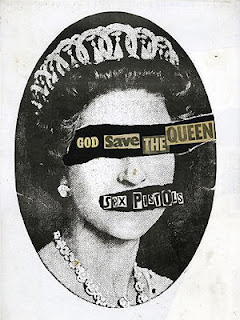

God Save The Queen – Jamie Reid

“One chord is fine, two chords is pushing it, three and you’re into Jazz.” – Lou Reed

God Save The Queen by Jamie Reid is an example of post-modern design in a movement that is explainable as postmodern. Punk was a nihilistic movement that came out of pessimism and anger directed at the establishment and the academics in art and music. Punk didn’t require people to have great skills in music, the three chord song was a term used to describe the generic punk record. The image above is a montage of newspaper cut outs and photography that has been deconstructed. Photography could already be classed as postmodern in the sense it captures something that has already happened, and the fact that this image is a famous image already taken by another photographer adds another step to distancing the artist from the image and creating a montage. It is also referencing traditional British culture with the reference to the national anthem by physically deconstructing it using British newspaper cuttings. It has “drawn heavily on recognisable imagery, presented in visual terms that reflect late twentieth century life.” Fehr, 1994, Studies in Art Education, Vol. 35, No. 4.

Now this image has become just as much a British icon as the image of the queen herself. The fashion designer Vivienne Westwood also used these ideas in her clothes. She made items of clothing out of other bits of clothing, torn, cut and stitched back together, montaging and references previous design ideas. The shop she opened to sell these clothes was called SEX boutique, this was typical to Punk, trying to shock and annoy the establishment. It is like calling a band “The Cunts” (a Chicago punk band) or the Sex Pistols swearing on the BBC when they were specifically asked not to. Geoffrey Sirc relates Hip-hop to Punk through this idea that ‘Gangsta (Hip-hop, Gansta Rap,) like Punk, like Malcom X, is all about using a kind of plain speak grammar and lexicon, charged with as much poetry as one can muster, to fashion a desperate politics of decency in an indecent world.’ Sirc, 1998, College Composition and Communication Vol. 49, No. 1.

Being offensive just for the sake of being offensive reflects the post-modern ideology of art for art’s sake or a focus on the aesthetic. It was not practical for the Sex Pistols to start swearing on Live TV, but they did it anyway. Punk was also associated with Anarchy and Autonomy. Autonomy fits in with the post-modern ethos (if you’re allowed to call it an ethos.) Autonomy exists in its own sphere, it is not concerned with fitting into society or having a particular message (what Hebdige calls 'implosion of meaning') but this is not to say that it doesn’t carry a message, if that were the case then you wouldn’t be able to discuss it. This reflects how post-modernism can be a subject to discuss without having a particular definition.


Hip Hop Rat – Banksy

‘The four elements of Hip Hop are Graffiti, Emceeing, Deejaying and Breaking.’ – DJ Africa Bambaata

Malcom Barnard quotes Hebdiges list of some of the things that have been labelled as postmodern in his book ‘Graphic Design as Communication.’

“the décor of a room, the design of a building… a television commercial or an arts documentary… the layout of a page in a fashion magazine or critical journal… the ‘predicament’ of reflexivity… a fascination for images, codes and styles… the ‘decentring’ of the subject … the ‘implosion’ of meaning, the collapse of cultural hierarchies [and] ‘placelessness’ (Hebdige 1988:181-2) Barnard. 2005. Graphic Design as Communication. P.139, Routledge Publishing

Graffiti and Deejaying, it could be argued, are both postmodern practices. In Promise and Paradox: Art Education in the Postmodern Arena, Dennis Fehr says ‘Thus far the art of this era called postmodern has drawn heavily on recognisable imagery, although often presented in visual terms that reflect late twentieth century life, such as neo expressionism, installations, graffiti art, performance art, and computer and video imagery.’ Fehr. 1994, Studies in Art Education, Vol. 35, No. 4. In Deejaying you have a musician that is also a technician. He samples other people’s works and plays them in a sequence of his own choosing and style. He creates a montage that is homage to other artists and styles of music and art. The audience are also an active part of the performance, a Deejay may change his set according the audiences reaction so it is constantly criticized and adjusted. The turn table was designed to play a record. It was a modern device and a celebration of being able to recreate recorded music on mass. A recording artist, before the deejay movement, made his musical pieces to be played from start to finish, the deejay ‘decentres the subject’ by sampling parts of the music to create a new subject. The same can be argued with graffiti art (art, painted in the street, outside of galleries, in an urban environment.) An architect, structural or civil engineer comes along and designs a building or public installation to serve a function and to look how he wants it too. More often than not in urban environments the designs are modern. He may express modernity through the medium of his structure. A graffiti artist then comes along and uses this structure as a canvas, ‘decentring’ the original subject and responding to it. He paints a design of his choosing montaging style of the building with his own work and whatever references to other ‘codes and styles’ it contains, creating a post-modern piece of artwork. In this method, the ‘Graff artist’ also questions ‘cultural hierarchies’ by placing what is sometimes a skillfully painted image outside of the gallery. This could be compared to Warhol's postmodern practice of putting mass produced work into galleries.

In Banksys piece above he homages Hip Hop culture through depicting a rat (a character he frequently uses in his own work) wearing clothes associated with the Hip-hop movement, it wears a New York City hat, (the Bronx in New York is generally seen as the origin of Hip Hop) in an urban environment with a boom box. He presents the work on another piece of design (the building.) In doing this Banksy in line with Hebdiges definition of postmodernism, ‘decentres’ the subject and makes it into something else, a canvas.

Banksy as a phenomenon fits in well with Hebdiges definition. As an artist he questions the cultural value of graffiti art. His work sells for thousands of pounds, whereas graffiti in a modern environment before was seen as vandalism. He is constantly referencing other codes and styles as with his ‘Hip-hop rat,’ above. He was also recently seen to try and ‘decentre’ himself and his work as the subject in his recent film “enter through the gift shop” which was marketed as the Banksy film but in fact was (in the simplest interpretation) a documentary made by him, but about another artist.

My understanding of Postmodernism is that it is a concept used as a tool for academics to discuss something that is part modern, part something else. As post-modernism doesn’t lend itself well to being tied down and defined, it becomes almost useless as a concept for anyone who isn’t involved in the academic art world. Charles Jenkes supports this by saying it is ‘doubly coded, one-half Modern and one-half something else in its attempt to communicate with the public and a concerned minority, usually other architects.’ Jenkes, 1987, Chicago Review, Vol. 35, No. 4

In this essay I have defined postmodernism, and sought to prove that aspects of visual communication can indeed be classed as ‘postmodern,’ by showing that postmodernism is a response to living in a state of postmodernity and reacting to that in the form aesthetic styles.

Bibliography

http://www.movmnt.com/monsters-of-hip-hop-2_003332.html

(DJ Afrika Bambaata quote)

http://www.metmuseum.org/toah/hd/vivw/hd_vivw.htm

(Vivienne Westwood – The mother of punk)

http://www.visual-arts-cork.com/postmodernism.htm

(Postmodernism in the visual arts)

http://tomwctt.blogspot.com/2010_12_01_archive.html

My lecture notes

http://www.flickr.com/photos/timtimes/3219609202/

Source for hip-hop rat

http://www.socialistworker.co.uk/art.php?id=11733

Pop, politics, hip-hop and post punk

http://thebesttraveldestinations.com/guggenheim-museum-bilbao-spain/

Source of Guggenheim image

http://en.wikipedia.org/wiki/File:Pruitt-igoeUSGS02.jpg

Source of Pruitt image

http://www.brainyquote.com/quotes/authors/b/brad_holland.html

Source of Brad Holland quote

http://www.imdb.com/title/tt0130515/

Andy Warhol’s “Blow Job”

Goldhagen, W, S. 2005. ‘A dynamically asymmetrical distribution of spaces. An absence of ornament or historical reference Calvanist in its rigor, an “abstraction,” and a resulting emphasis on the composition play between elements or volumes.’ Journal of the Society of Architectural Historians, Vol. 64, No. 2.

Jenkes, C. 1987. ‘Doubly coded, one-half Modern and one-half something else in its attempt to communicate with the public and a concerned minority, usually other architects.’ Chicago Review, Vol. 35, No. 4

Sirc, G. 1998 ‘Gangsta (Hip-hop, Gansta Rap,) like Punk, like Malcom X, is all about using a kind of plain speak grammar and lexicon, charged with as much poetry as one can muster, to fashion a desperate politics of decency in an indecent world.’ College Composition and Communication Vol. 49, No. 1

Fehr, D, E. 1994. ‘Thus far the art of this era called postmodern has drawn heavily on recognisable imagery, although often presented in visual terms that reflect late twentieth century life, such as neo expressionism, installations, graffiti art, performance art, and computer and video imagery.’ Studies in Art Education, Vol. 35, No. 4.

Poyner, R. 2003, “advanced the idea that there are two kinds of postmodernism, a neo-conservative postmodernism of reaction and a post structuralist postmodernism of resistance.” No More Rules, Lawrence King Publishing

Barnard. M 2005. “globalisation, a post industrial world of consumption and communication, the challenging of cultural values and difference.” Graphic Design as Communication. P.138, Routledge Publishing

“the décor of a room, the design of a building… a television commercial or an arts documentary… the layout of a page in a fashion magazine or critical journal… the ‘predicament’ of reflexivity… a fascination for images, codes and styles… the ‘decentring’ of the subject … the ‘implosion’ of meaning, the collapse of cultural hierarchies [and] ‘placelessness’ (Hebdige 1988:181-2) Barnard. 2005. Graphic Design as Communication. P.139, Routledge Publishing

Appendix:

This is stuff that I took out becuase it sort of distracts of takes off from the main point but I want to leave in becuase it feels like relevant speculation.

Andy Warhol made a film with DeVerne Book Walter, an actor. However, in the film Bookwalter is not acting, he is in fact getting a blow job from a university professor. The medium of film is easy to define as post-modern because as a medium is records something that has already happened and reproduces it for the masses. There is no truth to materials and as an art form it is already historical.

Wednesday, 16 March 2011

Task 5: Reading a Photograph


In 'How Do We Read a Photograph?' from G. Clarkes book 'The Photograph', Clarke tells us that "The photograph achieves meaning through what been called a 'photographic discourse': a language of codes which involves its own grammar and syntax." (Clarke, 1997, The Photograph, p. 27)

Victor Burgin insists that the discourse of the photograph "engages discourses beyond itself, the 'photographic text', like any other, is the site of a complex intertextuality, an overlapping series of previous texts 'taken for granted' at a particular cultural and historical conjuncture". (Clarke, 1997, The Photograph, p. 27)

“Early commentators like Poe, as much as Hawthorne, Holmes, and Baudelaire, noted the literal rather than symbolic aspects of the photograph, ignoring the extent to which is replicated cultural meaning rather than actual things.” (Clarke, 1997, The Photograph, p. 27)

Clarke however, tells us clearly that “We need to read it as the site of a series of simultaneous complexities and ambiguities, in which is situated not so much a mirror of the world as our way with that world”. (Clarke, 1997, The Photograph, p. 28)

In Clarke’s teachings we are asked to realise that the photograph is always entropic in nature. Because of this, we are invited to, when reading a photograph, take into consideration what we know about when and where and how the photograph was taken, and assume that written into the image is social, historical and cultural message for us to decipher. This may be deliberate and a product of the skills of the artist, but it may also be a product of the photograph being a document, and therefore capturing a trace of ‘the real,’ no matter how hard the photographer tries to conceal it. We need to know that there is nothing passive about photography, “to ‘take’ is active. The photographer imposes, steals, re-creates, the scene/seen according to a cultural discourse.” (Clarke, 1997, The Photograph, p. 29)

So, like in any language, we need to understand that what the ‘speaker’ says could be loaded with information. What we have to do in order to read it is make educated speculations about the relationships between the ‘denotative’ elements and the ‘connotative’ elements.


The first thing that strikes me about ‘Danger’ is the colours of the warning signs of which there are two. The combination of red, yellow and black denotes danger instantly. The second thing that I notice is the bars and I immediately feel unease. The hierarchy of the imagery or order in which we view the elements is especially interesting in this image. We first see the warning signs as we are used to paying attention to these when we walk into a room in order to avoid risk of injury. Secondly the bars make for a feeling of claustrophobia and unease. I then saw the tureens perched on the edge of the table, as if they may fall at any moment, they are 'teetering on the edge'. The room is filled with unavoidable dangers. If we now take into account that this image was taken in a psychiatric hospital as part of a project on internal communication, we can really explore the connotative meanings of this image. The experience of viewing the image for the first time and beginning to read it is a taste of being imprisoned in an environment that gives an illusion of safety but that on closer inspection may not be safe at all.

After a moment’s thought, the fire alarm to the left of the gate may provide an opportunity for escape, surely the gate would open if it was pressed. But beyond the gate all we can see is an unknown shadowy corridor. This image connotes the questioning of the relationship between feelings of safety or unease, and the effects and benefits of containment for those in mental crisis, rather than for the people affected by someone in mental crisis.

Tuesday, 15 March 2011

Portfolio Task 4- Postmodernism

Keedy, J (1984), Graduate Studies in Fiber, No More Rules, Lawrence King Publishing 2003

Rick Poyner says in his introduction to postmodernism in graphic design, "where modernism frequently attacked commercial mass culture, claiming from its superior perspective to know whats best for people, postmodernism enters into a complicitous relationship with the dominant culture."

Keedy explained this image as an attempt at 'doing everything wrong.' This complies with what Poyner says about postmodernism having a 'complicitous relationship' with the status-quo. The artist himself talks about this piece being an exercise in postmodernism.


"Its typographic manner is revivalistic, its image is a neo-classical quotation, its atmosphere is historicist, but its effect comes from the fact that none of these constituent elements would normally find use in combination on a rock album cover."

In the above quote, Poyner lists reasons why this image is a piece of postmodern graphic design. It is historicist where as modernism was anti-historicist, it refers to neo-classicism. It is a hybrid, its effect comes from the blend of styles being out of place on a rock album cover.


Vanderbyl, M (1983), Connections Promotional Poster, 'No More Rules' Lawrence King Publishing 2003

In 'No More Rules' Rick Poyner notes that in this image "a stream of figures leap(s) from a modernist skyscraper symbolised by a grid, across a void, and on to the top of a classical column - a clear, if somewhat literal, appeal to the value of pre-modern cultural forms."

If postmodernism seeks to contradict modernism, and modernism values anti-historicism, this metaphor of leaping from a modernist skyscraper to a classical column can easily be interpreted as an illustration that shows support for the postmodern movement.


"The collage-like 'Kunstkredit' eshibition poster (1977) was constructed from seperate pieces of film layered together and fixed to a film base, then transferred directly to the offset litho printing plate. Weingart's complex pictorial spaces, unprecedented at the time, fused typography, graphic elements and fragments of photographs on equal terms. He exposed sections of the grid, violating its purity with jagged outlines."

Since this style was previously unknown, and it breaks the rules of modern graphic design, I would argue this piece is postmodern. Not only does it break the rules, it does it deliberately and purposefully, cutting across the perfection of the square grid with its jagged torn edges and rough triangles.


Friedman, D (1971) Typografische Monatsblatter No.1 magazine cover, http://www.uartsgd.com/GD40/Friedman/FriedmanTypography.jpg

Rick Poyner says in his book 'No More Rules', "a minimalist poster based on the letter 'N', created in 1968 for a film showing at the Hochschule fur Gesaltung un Ulm (where Friedman also studied), is in his own words, 'simple, restrained, orderly, static, exclusive, abstract, pure, reduced, harmonious, systematic, and integrated'. By contrast, a 1971 cover for Typografische Monatsblatter, in which a series of letterforms found in Times Square, Manhatten, float above the city, is 'complex, excessive, chaotic, dynamic, inclusive, vernacular, contextual, expanded, dissonant, random, and fractured.'

This is a postmodern piece of graphic design. Friedman demonstrated his knowledge of modern graphic design by following the rules in his minimalist film poster, then demonstrated how he can break those rules totally and still create an aesthetically pleasing piece of work.

Monday, 14 March 2011

Portfolio Task 3 - Avant-Garde

Avant-Garde

noun
A group active in the invention and application of new techniques in a given field, especially in the arts."
The American Heritage Dictionary of the English Language, 4th Edition, Houghton Mifflin Harcourt Publishing 2010

Vincent Todolo described Lyubov Popova and Alexander Rodchenko as being "key figures in the modernist avant-garde."
Rodchenko and Popova: Defining Constructivism, Margarita Tupitsyn, Tate Publishing 2009

Margarita Tupitsyn said that they sought to "imbue the Bolshevik ambition of modernising the country with the aesthetic of the avant-garde."
Rodchenko and Popova: Defining Constructivism, Margarita Tupitsyn, Tate Publishing 2009

Taking this evidence into account, we can assume that Rodchenko and Popova were producing works that could be described as avant-garde. By definition, revolution means that the people seek a new way of life. This is also provides evidence to say that the designers of the Russian Revolution sought to be avant-garde.

Costume Design, Popova, 1923

"I dont think non objective form is the final form: it is the revolutionary condition of form." Popova, 1921, Rodchenko and Popova: Defining Constructivism, Margarita Tupitsyn, Tate Publishing 2009

Popova sought to create non-objective form. By non objective form, Popova is describing an avant-garde way of design in that they are designing real life objects in a way that is unrepresentational and non egotistic, it looks like it couldlve been made by a machine. Glen Adamson makes this observation, in reference to Popova and Rodchenko he says, "unlike their paintings from about five years earlier, the drawings themselves are made to look as uninflected as possible, like they were produced automatically. Partly this was to imply that their approach to design was egalitarian. Their own skill in rendering the object was beside the point; it could only detract from the democratic re-invention of everyday life."
Glen Adamson, Blog: From Sketch to Product, The Victoria and Albert Museum (internet - unknown date)

Egalitarianism was a socialist ideal that was being strived for after the Russian Revolution. Since this is the case, we can can note that this design has the avant-garde quality of chipping away at the status-quo.


Design for an aircraft hangar, Alexander Rodchenko 1923

This is another example of the above ideas in avant-garde Russian graphic design of the time.
Rodchenko said "the quest for construction has led the artist through a stage of experimentation with spatial structures to the design of actual things, i.e. to industrial manufacture in which the artist will become the designer of physical objects."

The act of playing with spatial structures in aid of learning to create something new was an avant-garde practice in Russia. This renders the above design avant-garde.


Tuesday, 8 February 2011

Old Spice | The Man Your Man Could Smell Like - Analysis of 'Othering'


I would argue that this is an example of post-modern 'othering.'
It contrasts the modern ideal that we can be a perfect human by buying a certain product but still uses that as a selling point. The adverts shows an advertising stereotype of the 'ideal man,' (buff, deep voice, rides horses.. owns a boat..?) who is in fact bigotted and ignorant to the advertising stereotype of womens needs (material possessions, expensive romantic gestures etc. etc.) We think 'I dont want to be like him, but i appreciate that women would at least find him physically attractive.' He then suggests that we can smell like him and so the thought process continues.

A part of physical attractiveness is the way we smell, we know that pheromones play an important part in the chemistry of attraction. The man we are presented with in this advert is unoriginal, boring, a typical physically strong male specimen who is presented as a ladies man. This is where the postmodern 'othering' starts, we think 'yeah we don't want to be anything like him, but unfortunately basic attraction is fact of life. So maybe smelling like him wouldn't be a bad thing. Another element to this advert is that it is definitely funny, so in associating old spice with humour (a quality I'd argue is desirable) we can bring the advert as an idea (although not the man as we are laughing at him,) into the 'us' realm and adopt it as something good.

'Yeah. Old Spice is funny. I'll buy that. Maybe I'll get laid because it'll be funny, nothing like the guy in the advert who has no idea.'

Wednesday, 2 February 2011

Seminar: Identity


According to Jacques Lacan the creation of identity happens at the "mirror stage."

A child reaches a stage between 6 and 18 months old when it has a moment of realisation (albeit in illusion) that it is a whole and complete person and recognises its own reflection in the mirror as confirmation.

According to Lacan we strive to experience this moment again for the rest of out life.
So then we can say that the mirror stage is characterised as "an illusion of wholeness" and "receiving views from others" which means our subjectivity is fragile and easily exploited by the advertising industry.

"Otherness" is a concept that relies on the assumption of opposition, "us and them" and gaining security in out subjectivity by distancing ourselves from people who do things we dislike for one reason or another.
If we create our identities this way, we can assume that so does a society.

"this question of difference and otherness has come to play an increasingly significant role... difference is ambivalent. It can be both positive and negative. It is both necessary for the production of meaning, the formation of language and culture, for social identities and a subjective sense of the self as a sexed object - and at the same time, it is threatening, a site of danger, of negative feelings, of splitting, hostility and agression towards the Other."
- Stuart Hall 1997, Representation: Cultural Representation and signifying practices. London P.238

Culture is the framework within which our identities are formed, expressed and regulated.


Historical Phases of Identity:

Douglas Kellner - Media Culture: Cultural Studies, Identity and politics between the Modern and the Post Modern, 1992

Pre Modern Identity: personal identity is unstable - defined by long standing roles

Modern Identity: modern societies begin to offer a wider range of social roles. Possibility to start choosing your identity rather than simple being born into it. Perople start to worry about who they are.

Postmodern Identity: accepts a fragmented self. Identity is constructed.


Pre modern identity:

institutions that determined identity were marriage, the church, monarchy, government, the state and work.

Fixed social roles defined at birth.

Modern Identity:

Baudelaire introduces the concept of the "Flaneur" or the "Stroller." A leisurely figure that strolls around in a modern culture. Like loitering about, enjoying the culture.

The "Trickle Down" theory is that the lower classes take fashion from the upper classes, although now it could be argued that there is a trickle up effect where street fashion is reaching the upper classes.

Simmel

'The feeling of isolation is rarely as decisive and intense when one actually finds oneself physically alone, as when one is a stranger without relations, among many physically close persons at a party, on a train, or in the traffic of a large city." - 1908

- because of the speed and mutability of modernity, individuals immerse themselves in a personal world to find peace

- the seperation of the subjective from the objective life

Essentialism - Our biological make up makes us who were are. Nature over Nurture.

Post modern theorists are anti-essentialist - Nurture over Nature.
Read social constructionism - building our own world.

Goffman - "the self is a series of facades"

Zygmunt Bauman - Identity is revealed to us only as something to be invented rather than discovered; as a target of an effort, "an objective."

"Introspection is a dissapearing act. Faced with moments alone in their cars, on the street or at supermarket checkouts. More and more people do not collect their thoughts, but scan their mobile phones for some shred of evidence that someone somewhere may need or want them."
- Andy Hargreaves

To live in a state of post modernity is to be a cultural spectator. Increasingly solitary. Revelling in a domesticated world at a distance through telemediation.

Postmodern identity...

Identity is constructed out of the discourses culturally available to us.

Age
Class
Gender
Nationality
Race / Ethnicity
Sexual Orientation
Education
Income

Etc Etc

Identities are established by the construction of "Others." Also through associating ourselves with groups to strengthen the opposition to "them."